“When the coach is calm, children can feel it”: Yuliia Klymenko on tennis, teenagers and working on yourself

In this series, we share the stories of people involved in the Marta Kostyuk Foundation’s projects. This time, we introduce Yuliia Klymenko, a coach from Cherkasy and a participant in the Sports Psychology Scholarship programme.
Yuliia has been playing tennis since she was seven, although her family’s story with the sport began even earlier. Her parents met on a tennis court and later decided to introduce their children to the game too. “They really enjoyed the game, and I suppose that’s why they later wanted my brother and me to try it as well. I was an active child, and I have a younger brother, so our parents thought we might enjoy playing together.”
At first, the training was not professional. At the time, Cherkasy lacked qualified coaches, and an enthusiast was bringing children together to play tennis. Yuliia initially competed in local tournaments, and from around the age of twelve began travelling to other cities for competitions. Her parents then realised that she needed a stronger coach to develop further.
From taking on a group by chance to becoming a coach
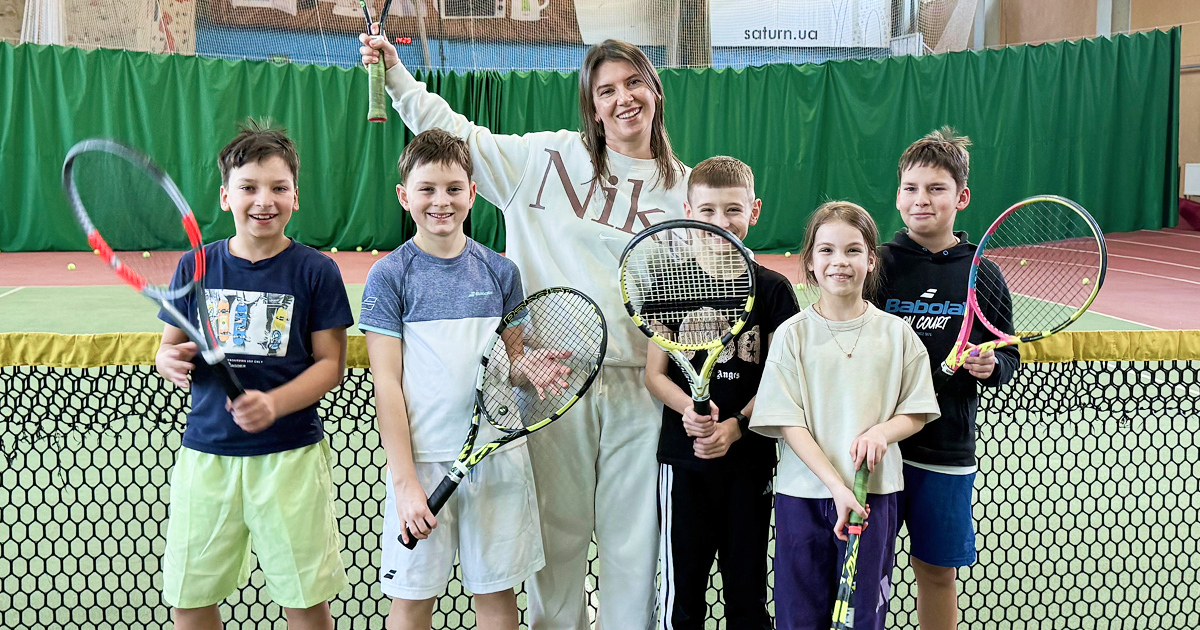
Yuliia had never planned to become a coach. She studied something entirely different: her parents wanted her to become an interior designer, while she was more interested in fashion design. It was the situation at the Selena tennis club in Cherkasy that eventually brought her back to tennis as a coach. As the number of coaches there gradually declined, Yuliia was asked to take on a children’s group so that they would not give up the sport altogether. By then, she had already stopped playing and agreed to give it a try.
When I started coaching, I realised that this was probably my purpose in life. I think it’s like a calling. I went on to get a second degree in physical education and sport. I studied in Kyiv. And I’m still continuing to learn because I don’t think you can ever stop: there’s always something new.
One of the important experiences early in her coaching career was working with a family from Canada. Yuliia coached a girl whose father was a hockey player, and they began exchanging their perspectives on training: she shared her experience from tennis, while he shared his from hockey. Around the same time, Yuliia began her ITF Level 1 training. “And the more I learnt, the more interested I became.”
Today, she works with children, adults and amateur players. She would like to coach more children who want to pursue tennis professionally, but, as she explains, putting together such a group is difficult at the moment: not every child or parent is ready for it.
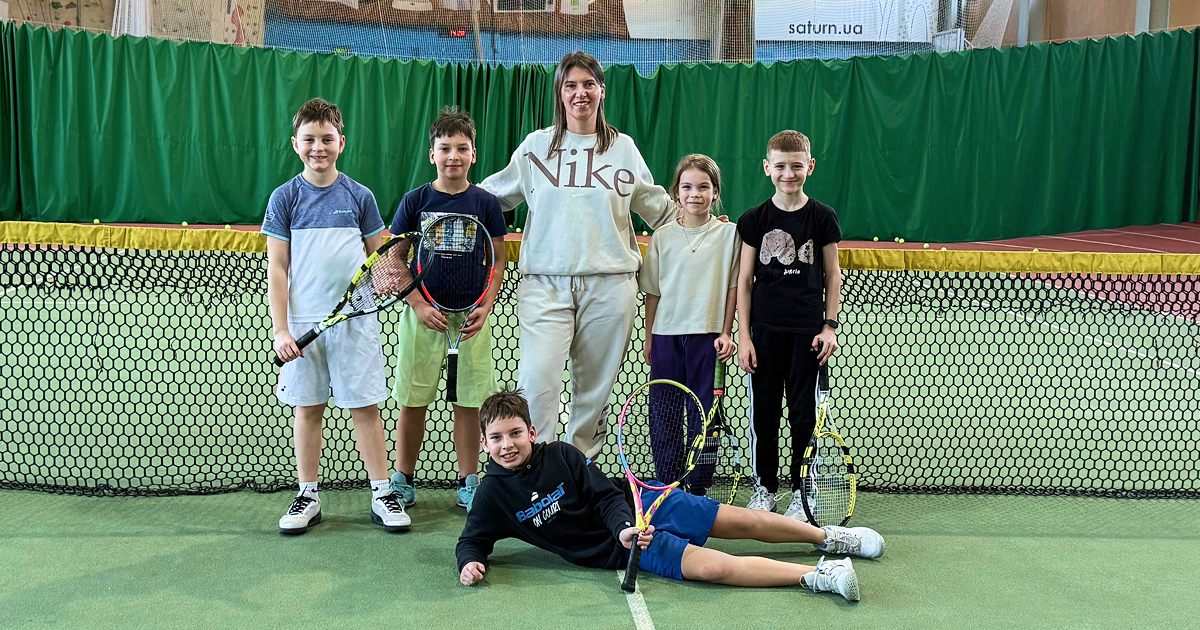
Yuliia also coaches her own children. Combining the roles of mother and coach is difficult, but the experience has taught her to look for different ways of communicating the same idea. “You go through so many different options and ways of getting your point across that it becomes easier with other children afterwards. You’ve already tried lots of approaches and you know that if one doesn’t work, you need to find another.”
“When the coach is calm, children can feel it”
Over the years, Yuliia has noticed that children are often more flexible than adults. Adults may already have established ideas such as “I won’t”, “I can’t” or “I don’t want to”, whereas a child can still be engaged and encouraged to try a different approach. But pressure, she says, affects everyone: both the top player who knows everyone wants to beat them and the player facing a stronger opponent who does not want to lose.
After taking part in the Sports Psychology Scholarship programme, Yuliia began to notice changes in her own work. Even during the course, she found herself responding more calmly to difficult situations in training. Participants were able to discuss real examples from their own work, ask questions and receive support.
This was particularly helpful when working with teenagers. Yuliia says the most challenging group for her is boys aged roughly 12 to 16: they may joke around instead of doing an exercise, argue or test the boundaries of what is allowed. Discussing these situations during the course helped her change the way she responded.
When children feel that you’re calm inside and staying within your own boundaries, their behaviour becomes calmer too.
Yuliia has also noticed the opposite effect: when a coach reacts sharply, children tend to react sharply too. They are very sensitive to pressure, so the adult’s emotional state becomes part of what happens during training.
For Yuliia, the value of the course was not limited to knowledge. The community of coaches with whom she could discuss similar challenges and exchange experiences was equally important. Some of the participants continue to share information even after completing the course.
“It’s great that you can meet coaches you wouldn’t normally come across in everyday life. It’s not just about learning, but also about feeling that you’re not alone with the questions you have. That’s very important for a coach.”
From learning to running her own workshop
One of the tasks within the programme was to run a workshop in her own city. For Yuliia, simply having to speak in front of other coaches was a new psychological challenge. She had never done anything like it before, and the audience understood the specifics of tennis well.
Yuliia chose goal-setting as the topic of her workshop.
It’s important not just to set a general goal like ‘I want to play better’, but to understand what to focus on, how to teach children to do this and how to explain to parents where we’re heading.
The course covered different sports, so while preparing for the workshop, Yuliia had to apply what she had learnt specifically to tennis. She describes it as a kind of final test after the course: she had to think everything through again and understand how to put it into practice.
The hardest part was not simply talking about goal-setting, but showing how to apply it. Yuliia ran an assessment with the coaches that they could later use with their own players. After the session, there was also an idea to hold a similar event for parents so they could better understand the coach’s work and their own expectations, and work together to determine where the child is heading.

What Ukrainian coaches are missing
When discussing children’s tennis in Ukraine, Yuliia first points to the need for systemic support. From what she sees, there are still quite a lot of girls playing tennis, while among boys there are sometimes not even enough participants to fill tournament draws. One possible solution, in her view, would be strong sports schools or a selection system that could identify promising children and provide some financial support to their families, as tennis involves significant costs.
Another challenge is infrastructure. Many people play tennis in Cherkasy during the summer, but opportunities are much more limited in winter because of the lack of indoor courts. “There are three courts at Selena and another two in the city, but we share those two with athletics because it’s their hall. It’s very difficult to build a proper training programme for an athlete in those conditions.”
At the same time, Yuliia is watching the rapid growth of padel. From a business perspective, she understands its appeal: several padel courts can fit into the space occupied by one tennis court, allowing more players to use the facility. But as a tennis coach, she would naturally like to see tennis receive more attention too.
Yuliia also highlights the importance of international experience for Ukrainian coaches. Last autumn, she travelled to Lithuania for a three-day global coaches’ conference, where she saw how federations and clubs in other countries build teams and invest in educating their coaches. The Ukrainian group paid for their participation themselves, which surprised colleagues from other countries.
I’d like speakers from other federations to come to us and for there to be at least short training events lasting one or two days. It’s about exchanging experience, support and motivation during the war. It’s important to feel that we haven’t been forgotten, that we’re not standing still and that we’re continuing to develop.
Yuliia also supports the idea of investing not only in athletes but in coaches. She would like to see more opportunities for internships and exchanges with other coaches, with education structured around athletes’ ages and levels: separately for working with children under 14, then players aged 16 to 18, and then adults.
More knowledge, more ways to help
Yuliia believes that wider knowledge of sports psychology can improve coaches’ qualifications and, in turn, the level of their athletes. She would like to see more coaching schools, a greater variety of approaches and more competition among coaches, as well as a clear certification system. In her experience, when a child initially ends up with an unqualified coach, time later has to be spent retraining them and addressing gaps in their technical and psychological preparation.
Yuliia describes the course in one word: “informative”. For her, its value also lies in the fact that learning does not end with the final lecture: it encourages coaches to keep looking for information, developing and trying new approaches in training.
Yuliia recommends this kind of training to coaches who are unsure whether they need sports psychology. “It helps you better understand the person or child you’re working with: to find common ground, encourage them when needed, prepare them to fight when needed, and understand their pain at a particular moment.”
For her, it is important to have tools that help identify changes in an athlete’s state, respond to them and support the child. The more information a coach has, the easier it becomes to work not only with athletes and their parents, but also with themselves.
For me, sports psychology isn’t a separate theory alongside tennis. It’s a way of seeing the child on the court more clearly: when they’re afraid, when they close themselves off, when they need support or simply a calm adult beside them.
And one of the main things Yuliia took away from the experience is simple: “When the coach is calm, children can feel it.”


“The one who never gives up”: the story of Prep School participant Yaroslav Pavlyshyn
Marta Kostyuk Foundation’s Prep School: Applications Open for a New Intake of Young Tennis Players
“Tennis is about atmosphere”: the story of coach-ambassador Valeriia Paraniuk