“The one who never gives up”: the story of Prep School participant Yaroslav Pavlyshyn

In this series, we share the stories of people involved in the Marta Kostyuk Foundation’s projects. This time, we introduce Yaroslav Pavlyshyn, a participant in Prep School, a programme that helps young tennis players prepare for university applications and combine their studies with sport abroad.
Yaroslav started playing tennis at the age of four thanks to his father. Not far from his home in Zolochiv was a health park with an asphalt tennis court, where he would go to play all the time.
My dad played tennis in our family, and he was the one who introduced me to the sport. There’s a health park not far from our home, and it has a tennis court, although it’s on asphalt. I used to go there all the time and I loved it. There was a coach working there, from the old school, and my dad signed me up with him.
Yaroslav has not put down his racket since. At first, he trained exclusively on asphalt, and two years ago clay courts were finally built in the city. When he was ten, his first coach died. “Fortunately, new coaches came along and took over,” he says. “I’ve now been coaching myself for a year and a half, helping the head coach with young children aged five to seven.”
His first experience of coaching proved more difficult than Yaroslav had expected. At first, the hardest part was not even explaining the exercises, but communicating confidently with the children.
It wasn’t easy at first, especially when it came to communication, because I was afraid to say things to the children or give them advice. But now, after a year and a half, I’ve gained experience, and it has helped me both in life and with communication in general.
Yaroslav also continues to compete in tournaments organised by the Ukrainian Tennis Federation, although he is not always able to make it to competitions. He was due to travel to Kyiv for the Ukrainian Championships, but the day before he was supposed to leave, his plans changed because of a warning about the threat of a large-scale missile attack. “I was supposed to go to Kyiv for the Ukrainian Championships. I really wanted to compete, but literally the day before I was due to leave, my parents told me I wasn’t going anywhere because there had been a warning about the threat of a large-scale attack. They simply wouldn’t let me go.”
From a distant dream to Prep School
Yaroslav first heard about Prep School during a training session in winter. His coach came across the opportunity while looking through different sporting and educational programmes. “My coach was looking through different sporting and educational opportunities and saw that applications had opened. He sent it to me and suggested I read about it and have a look. I became interested when I saw the opportunities to study abroad and combine studying with tennis.”
Until then, Yaroslav knew little about studying in the United States. He had read that many professional tennis players begin their journey at American colleges, but he did not know how to get there.
I didn’t know anyone who had done it, and my knowledge was very limited. I’d just read that quite a few professional tennis players start their journey at American colleges. It was this distant dream, but I had no idea how to get there, so I hadn’t really thought seriously about it.
So far, combining school and sport has not been particularly difficult for him: homework takes about an hour a day, leaving plenty of time for training. “An hour a day is enough for my homework. Since I’m still a top student, everything comes quite easily, and I have a lot of time left for sport.”
Preparing for the SAT and Duolingo English Test brought more unfamiliar challenges. Yaroslav had been taking additional English lessons since the fifth grade, so he could understand the teachers comfortably, but mathematical terminology proved unexpectedly difficult.
There were a lot of English terms in the SAT maths section that I hadn’t come across before. But everything was explained to me in detail and I was given guidance. For Duolingo, they taught us the right strategies: how to speak and how to find the right answers. Without the preparation at Prep School, I would have done much worse in these exams.
The maths itself was familiar; the main task was learning to understand the questions in English. “For example, terms like ‘right-angled triangle’ or ‘perpendicular lines’ were things I simply had to learn because I didn’t know how they were translated into English. But if you understand the wording of the question, it’s easy, around seventh- to ninth-grade level.”
When an interview feels more daunting than a tournament
The selection process included essays, tests and interviews. Yaroslav reached the final stage, which consisted of two conversations: one with Anastasiia Lutsenko and another with a UGS graduate. He was nervous before the first one, but the atmosphere quickly helped him relax.
Honestly, I was very nervous before the interview. It was the final stage, so I’d been thinking about it a lot. But when I joined the conversation with Anastasiia, she greeted me very warmly, and for the first fifteen minutes we spoke Ukrainian. Everything was calm, with no pressure at all. I relaxed and answered questions freely about my goals and why I had chosen Prep School.
The second interview was conducted entirely in English. “It was a little more difficult, but I was still able to speak to her freely. Overall, everything took place in a very relaxed atmosphere, even though I’d expected it to be much scarier.” Interestingly, the unfamiliar academic experience proved more psychologically challenging for Yaroslav than tennis tournaments. “I’m on the court regularly, so I’m used to that environment. But writing application essays or doing interviews in a foreign language was something I’d never experienced before. When an experience is new, it feels unfamiliar and there’s always a certain amount of fear.”
There are nerves before matches too, but Yaroslav has already learnt how to manage them. “I do get nervous, but not to the point where I’m shaking. I’ve played far more than one tournament by now, and I know how to control my emotions using breathing techniques. I go onto the court feeling fairly calm; I don’t get the jitters. Maybe there are a few more emotions at decisive stages of tournaments.”
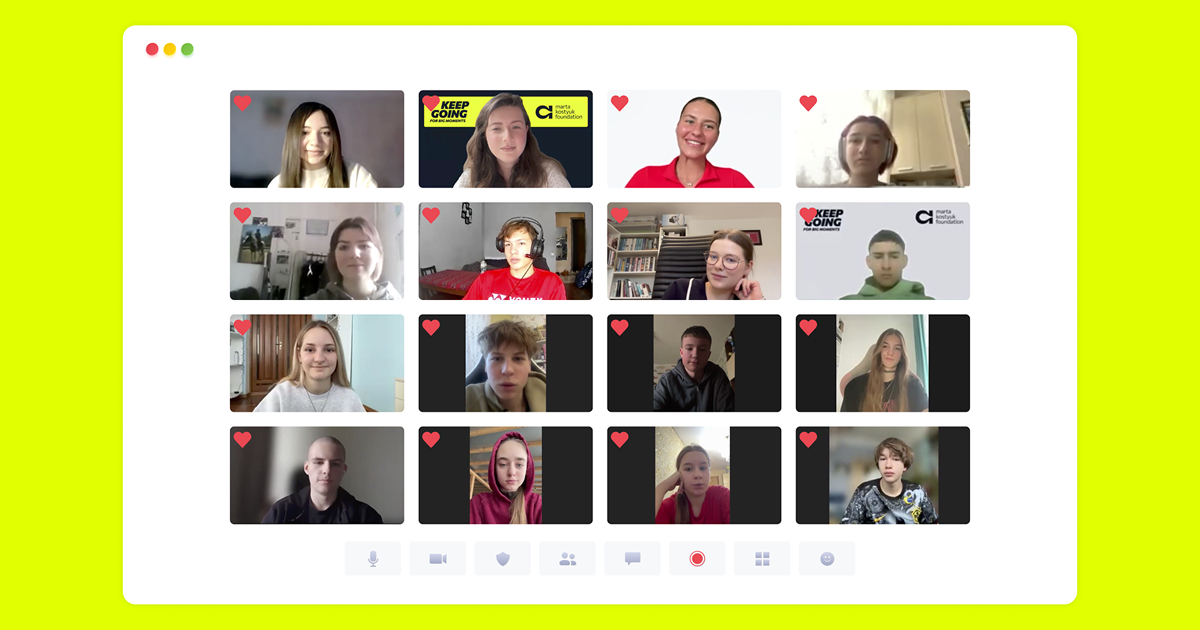
Of all the Prep School lectures, the meeting with Marta Kostyuk stayed with him the most. One idea in particular stood out: separating tennis from life beyond the court.
What impressed me was that every fifteen minutes she would write down some key points and start reading them back. And she said one thing that really stayed with me: that you shouldn’t mix your tennis life with your everyday life. In other words, don’t overthink things after matches: once you’ve come back from a match, you’re already a different person.
In the past, drawing that line had been more difficult for him. “It felt as though without tennis I was nobody and couldn’t do anything, but now I clearly understand that they are two different worlds.”
“The one who never gives up”
If a film were made about his journey, Yaroslav would call it “The one who never gives up”. The hardest scene would take place when he was around ten years old. At the time, he trained with much older boys and experienced bullying. “The hardest scene happened when I was about ten,” he says. “I trained in a group with much older boys who were fifteen or sixteen. And they openly bullied me: when I was standing at the net, they would deliberately hit the ball at me as hard as they could. After that, I was afraid of the net for two or three years because they hit the ball so hard. They called me names too. The coach often didn’t hear it, and when I told him about it, he would sometimes tell them off.”
Among those boys was his own brother, who is six years older. At one point, the situation became so difficult that Yaroslav decided he wanted to quit tennis.
One day I came home after training and told my dad that because of the situation, I didn’t want to go to tennis anymore. My dad encouraged me and said he’d speak to the boys. He talked to them, and everything became fine. If he hadn’t stepped in then, I would have quit tennis one hundred per cent because I couldn’t take it anymore.
The second scene in this imaginary film would be completely different: the Zolochiv Cup. At the age of nine, Yaroslav competed in the under-16 category and faced his older brother in the final.
It was the Zolochiv Cup, which was held when our old coach was still there. They would bring out this big trophy. You didn’t get to keep it; everyone just got to carry it around in turn. It was the biggest trophy of the year. I played in the under-16 category even though I was only nine, and I faced my brother in the final. I beat him in that final! I was incredibly happy, I almost cried with joy. Beating my older brother when I was nine was really cool.
Today, the brothers train in the same group and have a friendly relationship. “We train in the same group and joke around. I don’t bring up that situation with him. He’s probably forgotten about it a long time ago, but I still remember it. We have a normal, friendly relationship.” Yaroslav has not yet told his brother about taking part in Prep School. “We don’t talk about it: when we go to training, we just arrive, train and go back home. Maybe I’ll tell him one day if the mood is right and ask what he thinks about it, because he’s older after all and might be able to give me some advice.”
Support at every stage
When Yaroslav talks about Prep School, he often returns to the support he received throughout the programme. In particular, he mentions Zoia, who helped with materials and stayed in touch throughout the selection process. “Zoia was always available. If, for example, I wrote to say I couldn’t attend a lecture because of a tournament, she’d reply that she’d send me the recording, and she always sent the materials. I never had to remind her. Then, at every stage, she would message me and ask what difficulties I was having and what tasks I’d been given. She was genuinely interested.”
Before the final interview, they had a separate meeting. “She arranged a separate meeting for me and explained the whole format: how everything would work, what would be best to do, that it was worth greeting them first, and that after the interview it would be better to send a thank-you email because it demonstrates your etiquette.” Yaroslav was not accepted this time, but the support continued after he received the result. “When I wrote to say that I hadn’t been accepted, she still supported me and told me I’d done really well to make it all the way to the interview on my first attempt.”
Yaroslav describes Prep School in three words: “support, learning, communication”. He also remembers the sessions on self-presentation and one simple technique he took away from them. “I really liked the speaker’s advice that before answering a question, it’s always worth pausing, thinking and not saying anything unnecessary. This method — think, formulate, explain — works really well.”
One of the most unexpected results was an improvement in his spoken English. Before the programme, Yaroslav considered speaking his weak point, but after the preparation it became his highest-scoring section of the Duolingo English Test.
I didn’t expect them to help me improve my English speaking so much because we really did talk a lot. I had some gaps in that area. At Prep School, we communicated a lot, and afterwards my Speaking score on the Duolingo English Test was 110 points — the highest result of all my sections. I’d always considered spoken English my weak point.
SAT maths also surprised him, as much of the material was familiar from the school curriculum. Another surprise was the opportunity to speak with people he had heard a lot about before. “I was nervous when I was sitting there with Marta Kostyuk or Anastasiia Lopata, who I’d also heard a lot about before. I was incredibly happy to see them and have the opportunity to talk to them.”
Looking for new opportunities
One of the main challenges in Yaroslav’s tennis development now is the lack of stronger opponents for regular practice in Zolochiv. “There’s simply no one left for me to play in Zolochiv; I beat everyone. I can’t travel to Lviv all the time, and I don’t know anyone there who I could arrange to practise with. I’m simply stuck in Zolochiv: I train, I beat everyone here, and that’s it.”
Studying abroad therefore remains a priority for him, and not only because of tennis. Yaroslav wants to improve his English and sees knowing the language as a way to open up more opportunities for his future. “Abroad, I’ll improve my English and become a native speaker. One of my dreams is to know English at B2 or C1 level. English opens any door; it’s understood almost everywhere in the world, wherever you go.”
Yaroslav plans to devote his eleventh-grade year to further attempts to gain admission. “If it doesn’t work out, then I’ll study somewhere here in Ukraine. But while I still have time, I’ll look for every opportunity to go abroad.”
He remembers spending around twenty minutes wondering whether he should apply to Prep School at all. Now, his advice to other young tennis players considering the programme is to give it a try.
Don’t be afraid to apply. There are wonderful teachers here who explain everything clearly. Nobody tells anyone off: if you don’t understand something, they’ll explain it to you calmly. There’s no criticism at all. If you don’t know the answer, they’ll ask someone else and then explain it to you afterwards. Even if you don’t get into university in America, you’ll still gain valuable experience and knowledge. Definitely apply, don’t be afraid and broaden your horizons.


“When the coach is calm, children can feel it”: Yuliia Klymenko on tennis, teenagers and working on yourself
Marta Kostyuk Foundation’s Prep School: Applications Open for a New Intake of Young Tennis Players
“Tennis is about atmosphere”: the story of coach-ambassador Valeriia Paraniuk